
Quiz Summary
0 of 15 Questions completed
Questions:
Information
You have already completed the quiz before. Hence you can not start it again.
Quiz is loading…
You must sign in or sign up to start the quiz.
You must first complete the following:
Results
Results
0 of 15 Questions answered correctly
Your time:
Time has elapsed
You have reached 0 of 0 point(s), (0)
Earned Point(s): 0 of 0, (0)
0 Essay(s) Pending (Possible Point(s): 0)
Categories
- Not categorized 0%
- 1
- 2
- 3
- 4
- 5
- 6
- 7
- 8
- 9
- 10
- 11
- 12
- 13
- 14
- 15
- Current
- Review / Skip
- Answered
- Correct
- Incorrect
-
Question 1 of 15
1. Question
A 52-year-old man with alcohol dependence and advanced cirrhosis presents with acute confusion. He is cachectic with tense ascites.
T 38.2 °C, HR 132, BP 96/64, RR 22, SpO₂ 96% RA. Chest is clear. Urea and creatinine are raised.
Which investigation is most useful now to identify the source of his infection?
CorrectIncorrect -
Question 2 of 15
2. Question
An 85-year-old man from a residential home presents with increased confusion. He has type 2 diabetes and prostatism. T 37.2 °C, HR 106, BP 85/55 mmHg, RR 24, SpO₂ 95% (air).
Venous blood gas: pH 7.32, HCO₃⁻ 18 mmol/L, lactate 2.5 mmol/L, Na⁺ 148 mmol/L, K⁺ 6.4 mmol/L.
He appears to be in circulatory shock.
Which would be the correct approach to initial intravenous fluid therapy?
CorrectIncorrect -
Question 3 of 15
3. Question
A 57-year-old man presents with a 3 cm horizontal laceration on the point of his chin after falling onto a glass. He has a beard. The wound is deep, clean, and repeatedly opens with jaw movement. He declines transfer for maxillofacial assessment and asks if it can be repaired in the ED.
Which of the following closure options would be most appropriate?
CorrectIncorrect -
Question 4 of 15
4. Question
A 22-year-old man says that he has been bitten by a police dog, causing wounds to the inside of each thigh. This image shows the inside of the left thigh, the right thigh wound did not break the skin. He is in good general health, and his tetanus vaccinations are up-to-date, with his fifth vaccination 6 years previously (age 16 years). Exploration of this wound suggested penetrating wounds from a dog’s incisors, the wound has been cleaned.
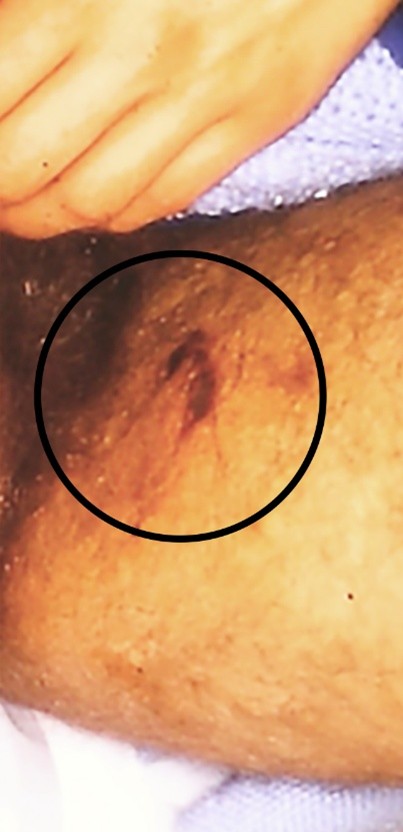
What is the most appropriate next step in management of this wound?
CorrectIncorrect -
Question 5 of 15
5. Question
A junior colleague asks for advice on tetanus prophylaxis. Which of the following wounds is high-risk (tetanus-prone) according to Immunisation against Infectious Disease (Tetanus, Chapter 30; UK Health Security Agency)?
CorrectIncorrect -
Question 6 of 15
6. Question
A 22-year-old woman is brought to the Emergency Department after being found collapsed and unresponsive in a park. She is breathing spontaneously and responds to painful stimuli by groaning. There is no clear history, and a toxicological cause is suspected.
According to RCEM guidance, which of the following statements about immediate management is most accurate?
CorrectIncorrect -
Question 7 of 15
7. Question
A 35-year-old man was behaving unusually at a music festival before being found unconscious in a parked van. He is brought to the Emergency Department. He is breathing spontaneously but is unresponsive with a Glasgow Coma Scale score of 3. There is no collateral history, and a toxicological cause is strongly suspected.
According to RCEM guidance on the management of patients with suspected but unidentified poisoning, which of the following investigations is most appropriate at this stage?
CorrectIncorrect -
Question 8 of 15
8. Question
A 19-year-old man presents with a 3-day history of painful swelling between his buttocks. He is otherwise well with no bowel or urinary symptoms. He has had a similar problem twice before, which have required incision. This image shows the painful area.
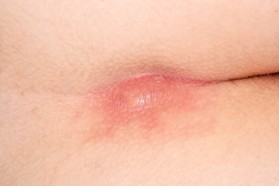
What is the most likely diagnosis?
CorrectIncorrect -
Question 9 of 15
9. Question
A 12-year-old boy sustains a displaced distal third fracture of the right radius and ulna (≈20° angulation) after a fall. The ED and orthopaedic teams recommend closed reduction (and possibly internal fixation if adequate alignment cannot be achieved). However after analgesia, he is comfortable in a sling; and he and his parents refuse reduction, stating “it will heal on its own.” Two senior clinicians have explained the risks of malunion and functional loss, but refusal persists.
What is the most appropriate next step?
CorrectIncorrect -
Question 10 of 15
10. Question
A 15-year-old boy is brought to the emergency department by his teacher after cutting his left thigh with a craft knife in an art lesson. He has a 2 cm superficial wound suitable for closure with tissue adhesive and Steri-Strips. He reports that his parents are currently abroad and unreachable; he is staying with a friend.
What is the most appropriate approach to consent for wound care?
CorrectIncorrect -
Question 11 of 15
11. Question
A 27-year-old male requires intubation and ventilation for life threatening asthma. He has been given an induction agent and neuro-muscular blockade. An attempt to intubate him fails, because of a limited view as the larynx could not be seen. Ventilation with a bag and mask was resumed, maintaining an acceptable oxygenation. At this point a more experienced intubator arrives
Which of the following is the best strategy now?
CorrectIncorrect -
Question 12 of 15
12. Question
A 74-year-old woman presents with acute neurological symptoms. Non-contrast CT head has been obtained; the abnormality is best appreciated on the axial slice shown (standard brain window).
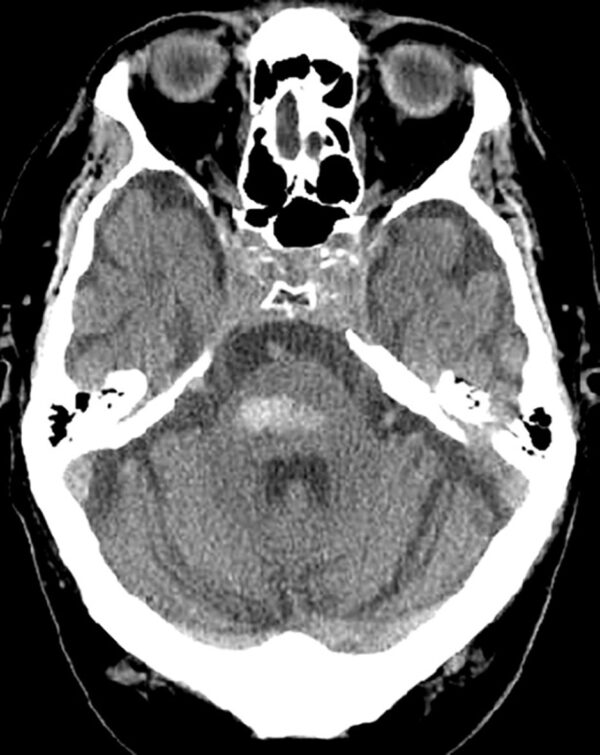
From the CT appearance, which neurological feature is most consistent with this lesion?
CorrectIncorrect -
Question 13 of 15
13. Question
A 72-year-old man presents after a short, witnessed generalised tonic–clonic seizure at home. This has never happened before. He has fully recovered by the time he arrives. His past medical history includes osteoarthritis, glaucoma, mild hypertension and atrial fibrillation. Routine medication includes timolol eyedrops, amlodipine, apixaban and paracetamol. Clinical examination is unremarkable and vital signs are normal. Routine blood tests are normal, glucose 6.8 mmol/l.
What is the most appropriate management?
CorrectIncorrect -
Question 14 of 15
14. Question
A 24-year-old woman presents after a first generalised tonic–clonic seizure. She is fully recovered and examination is normal. There is no fever, trauma, or focal neurology.
According to RCEM 2024 recommendations, which single investigation is specifically required in the emergency department?
CorrectIncorrect -
Question 15 of 15
15. Question
A 67-year-old man presents with new-onset headache and drowsiness. He has a history of hypertension and his blood pressure is persistently >220/120 mmHg despite having taken his usual amlodipine and ramipril. Examination reveals papilloedema but no focal neurological deficit.
An urgent CT head shows no intracranial haemorrhage or mass lesion.Which of the following is the single next best step in management?
CorrectIncorrect