
Quiz Summary
0 of 15 Questions completed
Questions:
Information
You have already completed the quiz before. Hence you can not start it again.
Quiz is loading…
You must sign in or sign up to start the quiz.
You must first complete the following:
Results
Results
0 of 15 Questions answered correctly
Your time:
Time has elapsed
You have reached 0 of 0 point(s), (0)
Earned Point(s): 0 of 0, (0)
0 Essay(s) Pending (Possible Point(s): 0)
Categories
- Not categorized 0%
- 1
- 2
- 3
- 4
- 5
- 6
- 7
- 8
- 9
- 10
- 11
- 12
- 13
- 14
- 15
- Current
- Review / Skip
- Answered
- Correct
- Incorrect
-
Question 1 of 15
1. Question
A 74-year-old man presents to the emergency department with epistaxis. The bleeding began four hours earlier and initially settled with simple first-aid measures at home. It restarted 40 minutes prior to arrival and has continued steadily since.
Which of the following is the most appropriate next step in management?
CorrectIncorrect -
Question 2 of 15
2. Question
A 22-year-old man has presented with a two-day history of sore throat. He is afebrile. The appearance of his throat on examination is shown below.
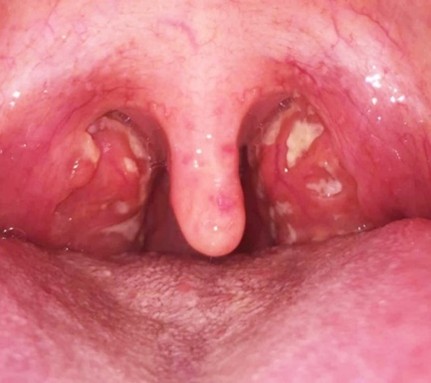
With regard to diagnosis, which of the following is most appropriate?
CorrectIncorrect -
Question 3 of 15
3. Question
A 70-year-old female has presented with a one-day history of right eye pain and blurred vision. This began suddenly after a day-case anaesthetic for a fracture manipulation.
Both eyes are shown in the picture.
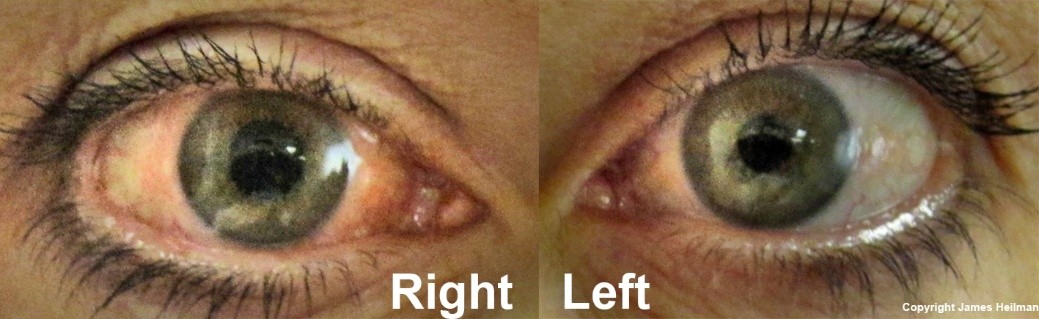
What is the most likely diagnosis?
CorrectIncorrect -
Question 4 of 15
4. Question
A 23 year old man has presented with a three day history of a painful left eye which also has reduced vision. He says that he had this before. It settled after about a month.
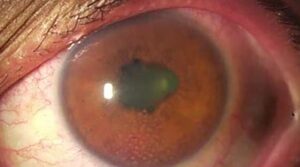
What is the most likely explanation?
CorrectIncorrect -
Question 5 of 15
5. Question
A 41-year-old woman presents to the Emergency Department 36 hours after an overdose of a large quantity of paracetamol. She reports nausea and vomiting overnight and now feels generally unwell.
Blood tests show:
Paracetamol <10 mg/L Sodium 138 mmol/L (135-145)
ALT 980 IU/L (10–50) Potassium 4.3 mmol/L (3.5-5.0)
INR 1.6 (0.9-1.2) Urea 6.8 mmol/L (2.5-7.8)
Bilirubin 32 µmol/L (3–21) Creatinine 118 µmol/L (60-110)
Albumin 38 g/L (35-50)
Alkaline 1hosphatase 92 IU/L (30-130)
What is the most appropriate next step in management?
CorrectIncorrect -
Question 6 of 15
6. Question
A 37-year-old woman has presented with a rash on her leg. She tells you that she saw an insect, which she thought was a horsefly, on her leg that morning while walking in a forest. She says that the insect gave her a painful bite. On examination, there is a 15cm area of tenderness and redness around the site of the bite. She is concerned that the bite has become infected.
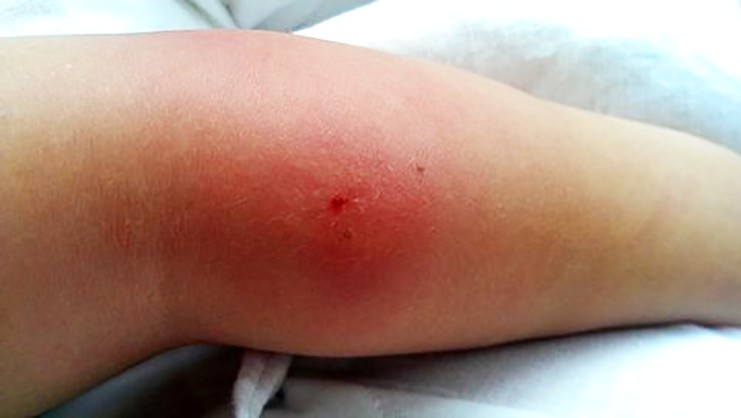
Which of the following is the most appropriate action?
CorrectIncorrect -
Question 7 of 15
7. Question
A 54-year-old woman presents with a 6-month history of gradually worsening breathlessness and a persistent dry cough. She does not speak English. On examination, you hear fine, late inspiratory crackles at both lung bases. She shows you a copy of lung function tests performed two months earlier:
FVC: 2.1 L (predicted 2.57 L)
FEV₁: 1.7 L (predicted 2.17 L)
FEV₁/FVC ratio: 80% (predicted 79%)
These results show a reduced FVC and FEV₁ with a preserved FEV₁/FVC ratio.
Which of the following is the most likely underlying diagnosis?
CorrectIncorrect -
Question 8 of 15
8. Question
A 38-year-old patient has been brought to the emergency department having been found unconscious at home. The patient has been intubated to protect his airway. However, he is breathing spontaneously.
The following capnography reflects the trend over 15 minutes.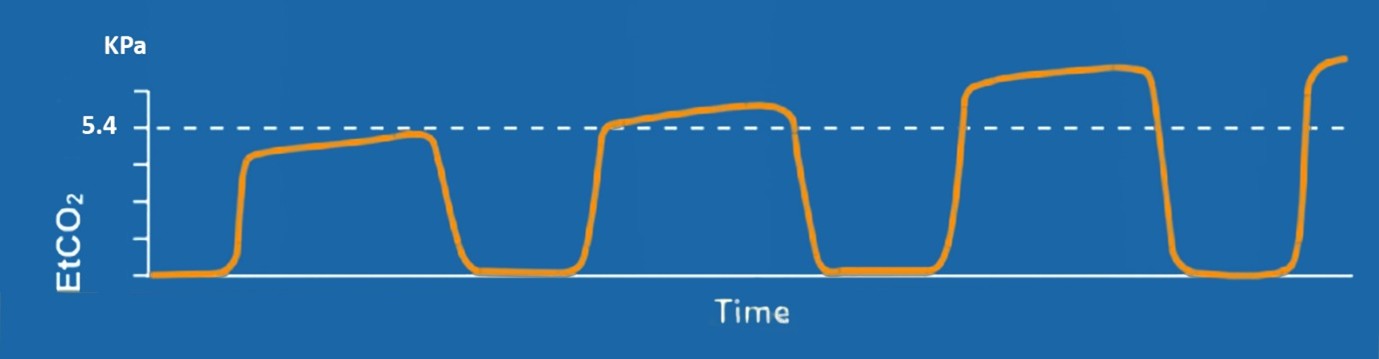
What is the most likely explanation?
CorrectIncorrect -
Question 9 of 15
9. Question
A 60-year-old man presents to the emergency department with severe pneumonia. He is febrile, tachycardic, and hypotensive. Despite receiving 2 litres of intravenous crystalloid, his blood pressure remains 80/55 mmHg, with a mean arterial pressure below 65 mmHg.
Which of the following is the most appropriate infusion to start next?
CorrectIncorrect -
Question 10 of 15
10. Question
An 87-year-old man presents with suspected infection.
Which of the following findings alone would now most strongly indicate high risk of severe illness under NICE NG253?CorrectIncorrect -
Question 11 of 15
11. Question
A 45-year-old man presents to the Emergency Department several hours after taking a large quantity of aspirin. He complains of nausea, vomiting, and tinnitus but is alert and haemodynamically stable.
A venous blood gas shows:
pH 7.44
pCO₂ 3.2 kPa
pO₂ 5.6 kPa
Bicarbonate 16 mmol/L
Which of the following best describes the acid–base disturbance?
CorrectIncorrect -
Question 12 of 15
12. Question
An 84-year-old man has presented with an acute exacerbation of chronic obstructive pulmonary disease. He is alert and is being treated with a salbutamol nebuliser at present. An arterial blood gas (ABG) is obtained (on face-mask oxygen) soon after his arrival and gives the following results:
pH 7.31
pCO2 8.4 kPa
pO2 7.3 kPa
HCO3– 29.8 mEq/L
Which would be the best treatment strategy?
CorrectIncorrect -
Question 13 of 15
13. Question
A 32 year old female with long-standing occasional mild asthma presents with a significant worsening of her symptoms over two days.
Which of the following over-the-counter medicines could have aggravated her asthma?
CorrectIncorrect -
Question 14 of 15
14. Question
A 28-year-old male presents to the ED with severe right hand pain and swelling after falling onto his outstretched hand during a soccer match.
This is his x-ray :
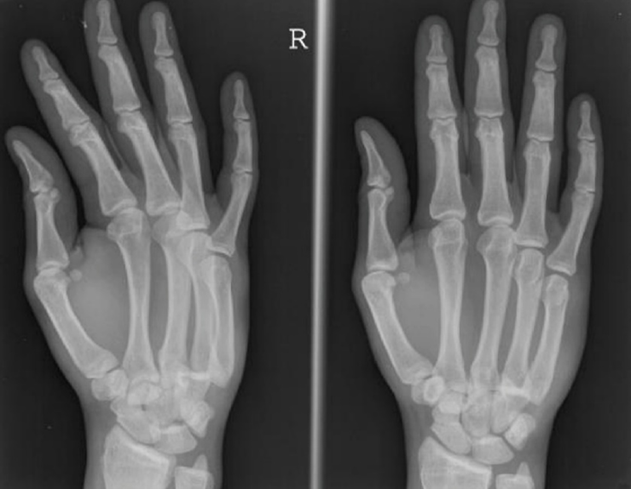
What is the diagnosis?
CorrectIncorrect -
Question 15 of 15
15. Question
A 17-year-old young man has injured his right shoulder in a rugby game and has presented to the emergency department with a great deal of pain and swelling around the shoulder. This is an anteroposterior x-ray of the shoulder.
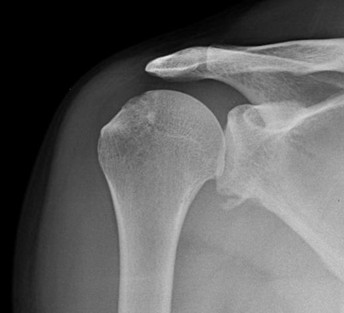
What is the most important early implication of this injury?
CorrectIncorrect