

Quiz Summary
0 of 15 Questions completed
Questions:
Information
You have already completed the quiz before. Hence you can not start it again.
Quiz is loading…
You must sign in or sign up to start the quiz.
You must first complete the following:
Results
Results
0 of 15 Questions answered correctly
Your time:
Time has elapsed
You have reached 0 of 0 point(s), (0)
Earned Point(s): 0 of 0, (0)
0 Essay(s) Pending (Possible Point(s): 0)
Categories
- Not categorized 0%
- 1
- 2
- 3
- 4
- 5
- 6
- 7
- 8
- 9
- 10
- 11
- 12
- 13
- 14
- 15
- Current
- Review / Skip
- Answered
- Correct
- Incorrect
-
Question 1 of 15
1. Question
A 45-year-old woman presents with a 2-hour history of severe unilateral throbbing headache preceded by 30 minutes of visual aura. She has suffered migraine in the past. She took two co-codamol tablets but vomited twice afterwards.
Which of the following treatments would be most appropriate?
CorrectIncorrect -
Question 2 of 15
2. Question
An 84-year-old woman is brought from a day centre because staff noticed noisy breathing since this morning. She has moderate dementia and is calm, not drooling, and speaking in short phrases. On assessment she has moderate inspiratory stridor at rest.
Vital signs: HR 68 bpm, BP 146/88 mmHg, RR 18, SpO₂ 96% (air), afebrile. Neck examination is normal with no tenderness or swelling. There is no rash and no choking was witnessed.
What is the most likely explanation for the stridor?
CorrectIncorrect -
Question 3 of 15
3. Question
A 78-year-old man has presented after an episode five days earlier. He noticed an episode of slurred speech and weakness of the right side of the face which resolved after 20 minutes. He now feels well and has no other symptoms and clinical examination is normal. He has been given 300 mg aspirin. His daughter encouraged him to get help.
Which is the most appropriate next management?
CorrectIncorrect -
Question 4 of 15
4. Question
A 57-year-old man was found unresponsive in a shopping centre. On arrival in the emergency department, he had visual disturbance and confusion, which improved over the next hour. CT head is normal. Although a stroke was initially suspected, his improvement has raised the possibility of a stroke mimic.
Which of the following is NOT generally considered a stroke mimic?
CorrectIncorrect -
Question 5 of 15
5. Question
An 84-year-old man has presented after a stroke. An image from his CT brain is shown. The radiologist indicates that this image shows a lacunar infarct (arrowed).
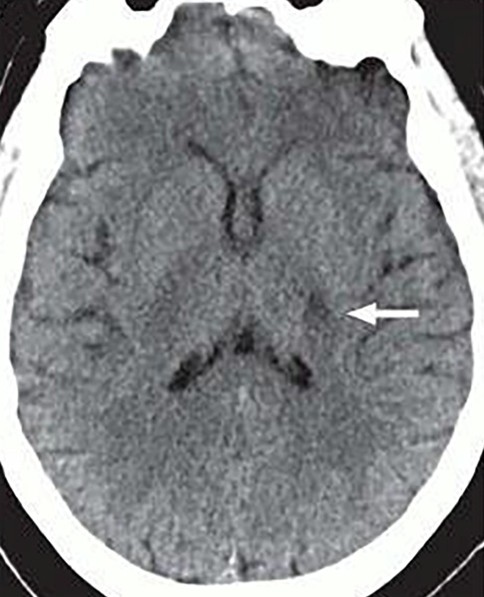
Which neurological deficit would be most likely to be found?
CorrectIncorrect -
Question 6 of 15
6. Question
A 43-year-old man has presented with an episode of chest pain. Which of the following features in the history would be most suggestive of a cardiac course?
CorrectIncorrect -
Question 7 of 15
7. Question
A 67-year-old man has presented with sudden onset chest pain radiating to the left arm. He is anxious, sweaty and nauseated.
His observations are as follow:
Temperature – 36.5 degrees celsius
Heart rate – 72 beats per minute
Blood pressure – 164/102
Respiratory rate – 22 breaths per minute
Oxygen saturations – 95% on room air
His ECG on arrival is below: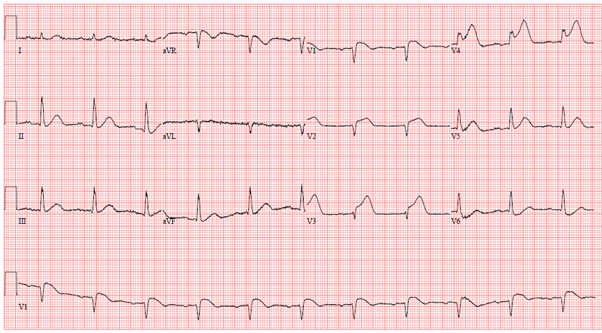
Which of the following complications is he most at risk of in the following hours?
CorrectIncorrect -
Question 8 of 15
8. Question
A 42 year old man has arrived in the Emergency Department complaining of severe chest pains. He admits to taking a cocaine two hours earlier. His pain has eased slightly since arrival.
His observations are below:
Temperature – 37.3 °C
Heart rate – 102 beats per minute
Blood pressure – 170/100mmHg
Respiratory rate – 20 breaths per minute
Oxygen saturations – 98% on room air
His ECG is below.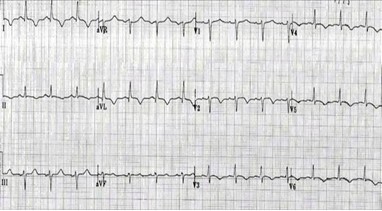
Which of the following is the most appropriate management strategy?
CorrectIncorrect -
Question 9 of 15
9. Question
An 82-year-old woman presents after a fall at home. She tripped in the hall while answering the doorbell and has only a small hip bruise.
Her past medical history includes osteoarthritis, hypertension, and insomnia. Her regular medications are:
- Amlodipine 10 mg once daily
- Paracetamol 1 g four times daily
- Diazepam 5 mg at night
- Omeprazole 20 mg once daily
She mobilises independently and lives alone. Her ECG and blood tests are normal.
Her blood pressure is 144/82 mmHg, with no postural drop.According to NICE guidance on falls prevention, which intervention is most appropriate before discharge?
CorrectIncorrect -
Question 10 of 15
10. Question
A 59-year-old man has presented with central chest pain and sweating, early in the morning, lasting about half an hour, which had nearly resolved by the time he arrived in the Emergency Department.
This is his ECG: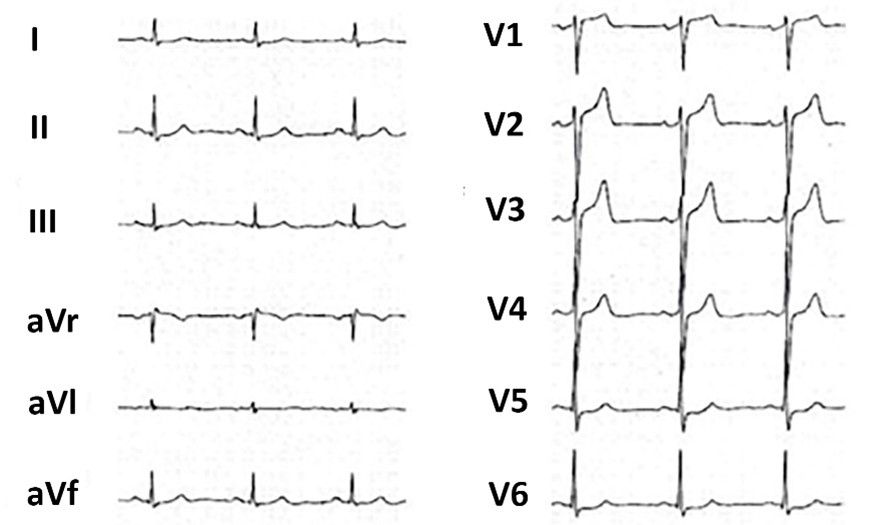
He had suffered similar episodes twice before. The possibility of coronary artery spasm is being considered (Prinzmetal’s Angina, Variant Angina).
Which of the following features would make coronary artery spasm more likely?CorrectIncorrect -
Question 11 of 15
11. Question
A 47yr old male presented to the Emergency Department at 3am with central chest pain which he described as ‘like a bruise’. He says that he first noticed this the previous morning and it has gradually got worse since then.
His ECG is shown:
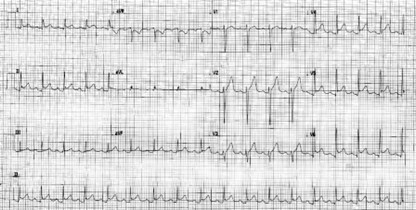
Which is the most likely diagnosis?CorrectIncorrect -
Question 12 of 15
12. Question
A 56-year-old man has presented with an episode of chest pain which began three hours ago and lasted for 40 minutes. He has no known medical history and takes no regular medication. He was given 300mg aspirin by the ambulance crew.
His observations are as follows:
Temperature – 36.2 degrees Celsius
Heart rate – 94 beats per minute
Blood pressure – 164/92mmHg
Respiratory rate – 22 breaths per minute
Oxygen saturations – 98% in room air
An ECG taken on arrival is shown below.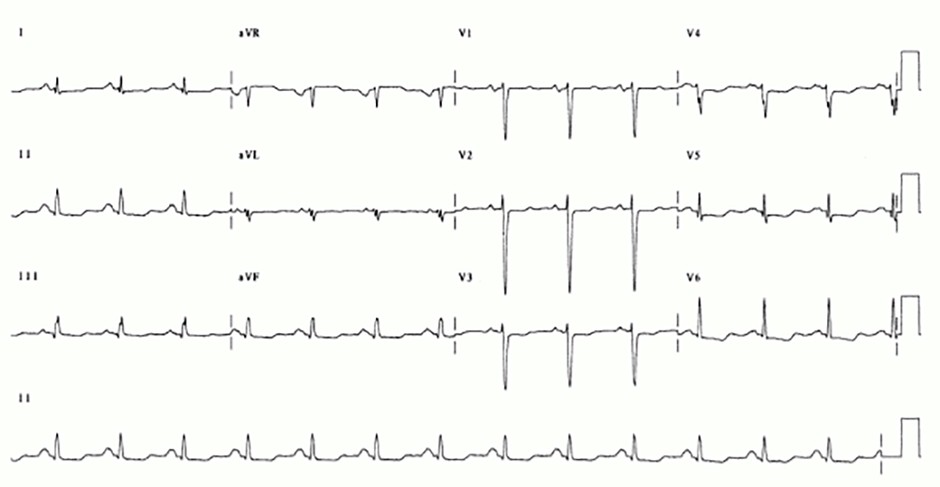
At first assessment in the Emergency Department what would be the most appropriate drug therapy?
CorrectIncorrect -
Question 13 of 15
13. Question
A 28-year-old man has come to the Emergency Department from a rugby game in which he suffered an injury to his nose. He is normally healthy and has not injured the nose before. The nose has stopped bleeding by the time it is examined.
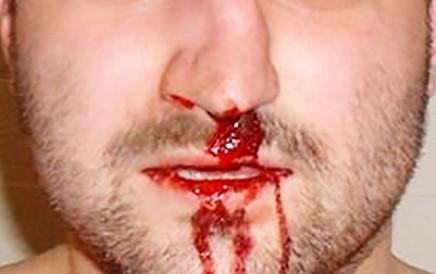
Which is the first management priority?
CorrectIncorrect -
Question 14 of 15
14. Question
You are asked to give your opinion on a CT image of an 11 year old child who is being managed by the paediatric department with a three-day history of difficulty swallowing. The child has become progressively more unwell and is now febrile, in significant pain and drooling saliva. A contrast enhanced CT has been undertaken and the staff are studying this image:
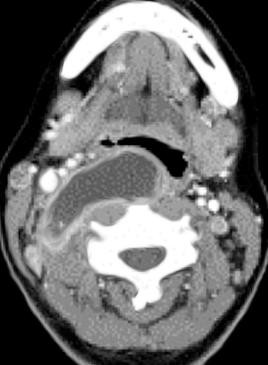
What is the most likely diagnosis?
CorrectIncorrect -
Question 15 of 15
15. Question
A 69 year old man has presented to an Emergency Department in a small isolated hospital with sudden onset chest pain which began 3 hours ago. He is sweaty and nauseated. If a decision is made to transfer, then the closest cardiac catheter facility is 2.5 hours journey time away.
His observations are as follows:
Temperature – 36.4 °C
Heart rate – 108 beats per minute
Blood pressure – 123/82
Respiratory rate – 18 breaths per minute
Oxygen saturations – 98% breathing room airHis ECG on arrival is as follows:
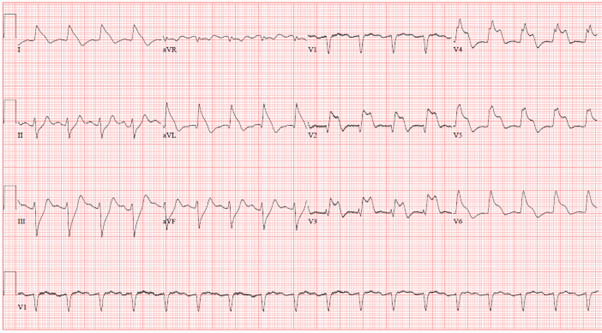
Which of the following is the most appropriate management in addition to aspirin and symptom control?
CorrectIncorrect