

Quiz Summary
0 of 15 Questions completed
Questions:
Information
You have already completed the quiz before. Hence you can not start it again.
Quiz is loading…
You must sign in or sign up to start the quiz.
You must first complete the following:
Results
Results
0 of 15 Questions answered correctly
Your time:
Time has elapsed
You have reached 0 of 0 point(s), (0)
Earned Point(s): 0 of 0, (0)
0 Essay(s) Pending (Possible Point(s): 0)
Categories
- Not categorized 0%
- 1
- 2
- 3
- 4
- 5
- 6
- 7
- 8
- 9
- 10
- 11
- 12
- 13
- 14
- 15
- Current
- Review / Skip
- Answered
- Correct
- Incorrect
-
Question 1 of 15
1. Question
A 62-year-old man presents to the Emergency Department with rapidly worsening pain in his right foot, 4 days after developing a small ulcer from a sandal rubbing while walking on the beach. He was started on oral flucloxacillin at an Urgent Care Centre 2 days ago. He is now febrile and systemically unwell. The foot is tense and markedly tender with pain out of proportion to the appearance on examination. There are dusky skin changes with tenderness extending beyond the erythema. There is no history of penetrating or contaminated trauma or recent surgery. He has Type 2 diabetes. This is an x-ray of the foot.
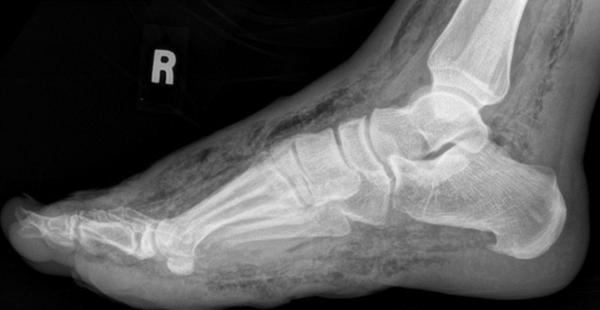
What is the most likely diagnosis?
CorrectIncorrect -
Question 2 of 15
2. Question
A 35-year-old patient remains in the Emergency Department for several hours following minor injuries sustained in a road traffic collision. According to RCEM guidance on providing information to patients, which of the following best reflects recommended practice?
CorrectIncorrect -
Question 3 of 15
3. Question
A 54-year-old man has presented with tender spots on his lower legs. He says that he is normally healthy and that this rash began about four days earlier. Each spot gradually becomes larger and tender and new spots appear. This only affects his legs, as shown in the photograph. He is otherwise well.
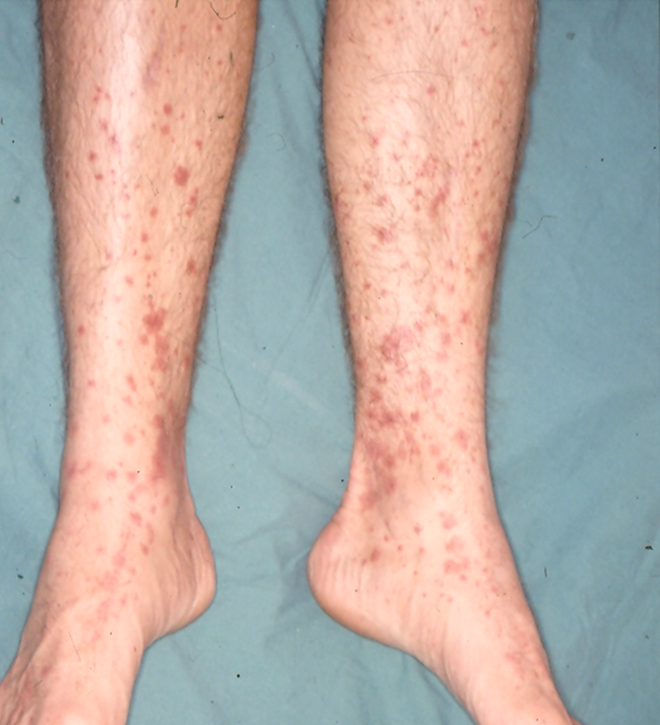
Which of the following diagnoses is most likely to account for this rash?
CorrectIncorrect -
Question 4 of 15
4. Question
An 83-year-old woman has been sent to the emergency department as a swab taken from an ulcer on her leg has grown ‘Coliforms. She says that the ulcer (see picture) is not healing after months, but is not painful and she feels well.
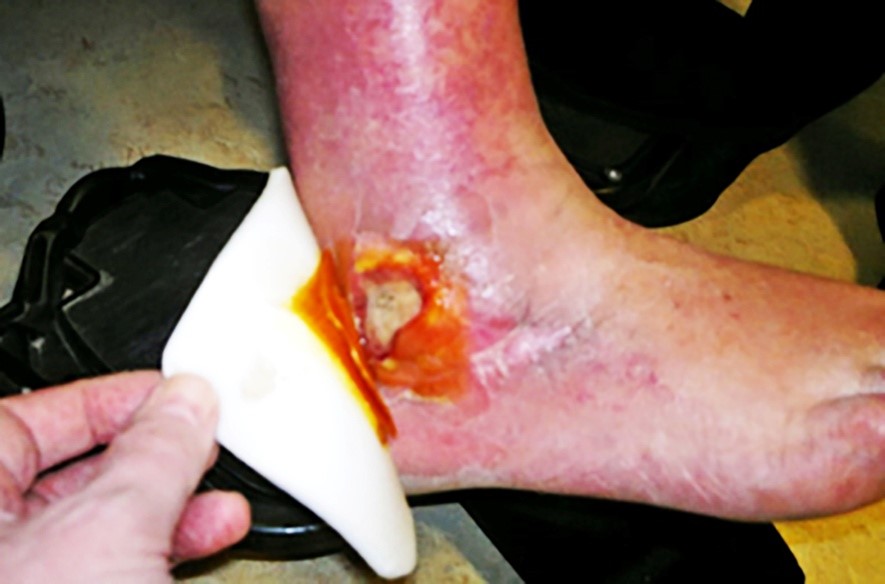
This What is the most appropriate action?CorrectIncorrect -
Question 5 of 15
5. Question
A test for subarachnoid haemorrhage has a sensitivity of 98% and a specificity of 65%.
What does this high sensitivity indicate in practice?
CorrectIncorrect -
Question 6 of 15
6. Question
A 46-year-old woman presents with a sudden, severe headache. She undergoes a CT head scan 12 hours after the onset of symptoms. The sensitivity of CT for subarachnoid haemorrhage falls after 6 hours, but the specificity remains very high (close to 100%).
What does the high specificity indicate?
CorrectIncorrect -
Question 7 of 15
7. Question
A 54-year-old woman with end-stage metastatic breast cancer (cranial involvement) is in the final hours of life. She is restless and agitated (moaning, pulling at lines) and increasingly distressed. She cannot take oral medication.
Which of the following is the most appropriate treatment for her agitation?
CorrectIncorrect -
Question 8 of 15
8. Question
A 48-year-old woman presents to the Emergency Department with left ear pain. The problem began a week earlier while on holiday. She was prescribed ear drops, but after three days reports that the pain has worsened. The ear is now tender to touch, with swelling of the external canal, a slight purulent discharge, and reduced hearing. The external view of the ear is shown.
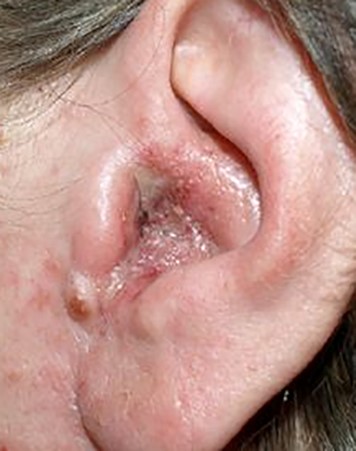
Which is the most appropriate next treatment?CorrectIncorrect -
Question 9 of 15
9. Question
A junior colleague has asked for your help interpreting an x-ray. A 71-year-old man has a sharp sensation of something stuck in his throat after eating fish and chips a few hours earlier. He is concerned about a fishbone. He has swallowed water and dry bread to try to clear his throat, but this has not resolved his symptoms. This is the x-ray:
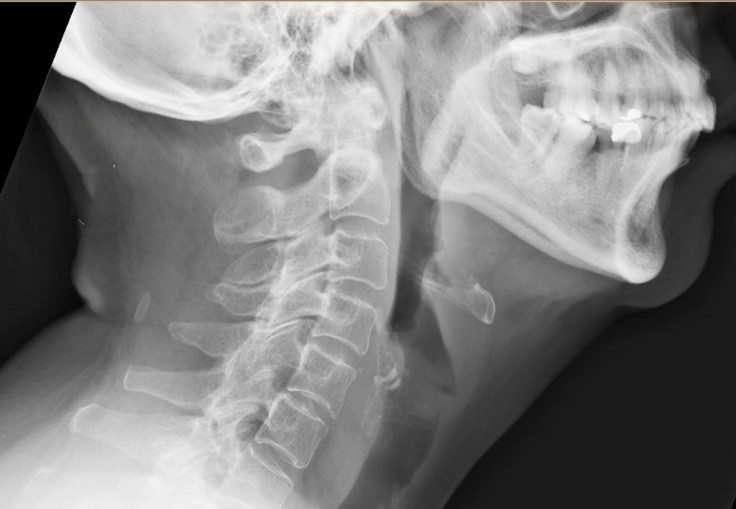
What would be the most appropriate advice?
CorrectIncorrect -
Question 10 of 15
10. Question
A 68-year-old man presents with a 24-hour history of worsening throat tightness and neck pain radiating to the ears. He is febrile (38.5°C), tachycardic (110 bpm), tachypnoeic (26/min), and has an oxygen saturation of 94% on room air. His voice is muffled, and there is anterior neck swelling and tenderness.
In suspected upper airway sepsis, what is usually the earliest clinical sign of impending airway obstruction?
CorrectIncorrect -
Question 11 of 15
11. Question
An 87-year-old man with a long history of heart and lung disease lives in a care home. Over the last two days he has become confused and is now aggressive and difficult to manage.
Which of the following initial assessments is most likely to be helpful in establishing the cause?
CorrectIncorrect -
Question 12 of 15
12. Question
An 88 year old female is complaining of recent worsening of low back pain causing her difficulty with daily tasks. The following x-ray has been taken:
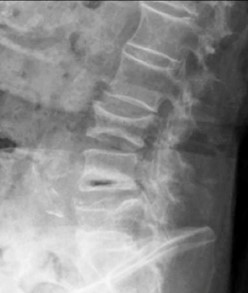
Other than her back pain, she is well and no other problems are identified.
Which of the following recommendations would be most appropriate?
CorrectIncorrect -
Question 13 of 15
13. Question
A 92-year-old woman with Parkinson’s disease, type-2 diabetes and ischaemic heart disease fell in a shopping centre. In ED no injury was identified and she mobilised. Because it was late, she was admitted overnight to the CDU. The next morning she is unexpectedly unable to get out of bed.
Which of these explanations is most likely?
CorrectIncorrect -
Question 14 of 15
14. Question
An 86-year-old woman has been brought to the ED having been unable to get out of a bath for three hours until she was found by her daughter. The house was warm and her temperature on arrival was 34.7°C. She has been rewarmed passively and now wants to go home.
Which of the following should be considered before discharge?
CorrectIncorrect -
Question 15 of 15
15. Question
Your emergency department regularly cares for patients with vaso-occlusive episodes (VOE) due to sickle-cell disease. A departmental working group has been set up to implement recent RCEM guidelines for the care of these patients.
Which of the following guidance is most accurate?
CorrectIncorrect