
Advancing Point of Care Ultrasound: From Evidence to Implementation Micro-Credential (PgCert Module)
This online course, delivered in collaboration with Canterbury Christ Church University (CCCU), focuses on the critical step that often sits between innovation and impact: turning ultrasound evidence into safe, effective clinical practice. Designed for clinicians who already use PoCUS, the module explores how emerging or less-established applications can be evaluated, justified, and implemented responsibly within real healthcare settings.
You will develop the skills needed to appraise the evidence underpinning novel PoCUS techniques, assess their clinical value, and understand the organisational, governance, and medico-legal considerations that influence adoption. The module emphasises practical decision-making, balancing benefits, risks, and barriers.
By the end of the module, you will be able to construct a structured, evidence-informed proposal for introducing a new PoCUS application into local or specialty-specific practice, linking research findings to realistic implementation strategies that support patient safety, service improvement, and sustainable change.
Next dates: 21st January – 25th March 2027
Fee: £900

Please note: Successful completion of the PgCert or individual micro-credentials confirms achievement of the relevant academic and practical learning outcomes. It does not by itself confer independent clinical competence or replace supervised workplace practice, professional accreditation, local governance requirements or workplace-based assessment (WPBA) sign-off.
What is a micro-credential?
A micro-credential is a short, specific course of study, with an assessment which earns credits. The Credit Accumulation and Transfer Scheme is a national UK university scheme to allow credits to be earned and accumulated. For example, a typical postgraduate diploma is 120 credits, a typical PgCert is 60 credits. Each of our micro-credentials earns 10 credits, with each credit representing the notional equivalent of 10 hours of study.
What is the commitment?
Each micro-credential requires 100 hours of notional study, most of which will be self-directed learning. However, for micro-credentials with a practical component, you must also complete 21 hours (3 days) of in-person, hands-on training at our London-based training centre if this is your first micro-credential with us, or 15 hours (2 days) if you have already attended one of our other micro-credentials. You can enrol on up to two micro-credentials per term.
What are the entry requirements?
- Professional Registration: Registered with the General Medical Council (GMC), Health & Care Professions Council (HCPC), or Nursing & Midwifery Council (NMC).
- Educational Background: A relevant first degree, such as MB BS (or equivalent), or a bachelor’s degree, ideally at first-class or 2:1 level.
- Clinical Experience: Current employment in an appropriate role within the NHS or a UK-based private healthcare provider, with evidence of basic ultrasound experience.

What does the course cover?
- Medico-legal and governance issues in adopting new ultrasound applications
- Literature review and critical appraisal skills relevant to PoCUS
- Frameworks for assessing the strength of evidence and clinical impact
- Barriers to clinical adoption (training, cost, resistance, policy)
- Risk-benefit analysis of new techniques
- Models for local implementation, including training, supervision, audit, and quality assurance
- Linking research evidence to practice change

How is the course taught?
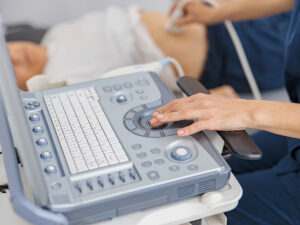
Unlike most of our other micro-credentials (PgCert modules), this course does not include practical scanning sessions. Instead, it is delivered through:
- Self-directed study, including engagement with current literature, clinical guidelines, and implementation science
- At least two one-to-one online support sessions with a faculty member, offering structured guidance and feedback
- Opportunities for formative feedback prior to final submission
How is the course assessed?
To earn the micro-credential, you must successfully complete both of the following:
- A written assessment (a 1,500-word structured assignment exploring the evidence base and implementation considerations for a PoCUS application in a chosen clinical context).
- An oral examination (a 15–20 minute viva with a faculty member, testing depth of understanding, critical thinking, and justification of proposals).
What doctors say about our PgCert and micro-credentials programme
Don’t Want to Miss Out?
Register your interest, and we’ll notify you as soon as the next course dates are open for booking!
Subscribe to Bromley Emergency Courses’ weekly email newsletter to keep up with the latest emergency medicine training news and courses
*By proceeding you give your consent to be contacted via email with updates on courses and events by Bromley Emergency Courses. You may unsubscribe from these communications at any time. We will never share your details with 3rd parties and will only use your email to send you information about our upcoming courses and other offers.